The States Where People Are Most Likely to Stay Close to Home
For most Americans, home isn't simply a dot on a map. It's a sense of self built up over time, informed by family ties, cultural familiarity, job opportunities, and personal identity. Where a person is born and where they choose to end up can say a lot about how economics and lifestyle shape regional culture.
While some states are known for having deep "stickiness," others often see people move away in search of fresh starts, better jobs, or more affordable housing. ThatsThem has pulled together data from the U.S. Census and Pew Research to outline how rooted Americans actually are, which states hold onto their residents, and what drivers indicate who stays and who leaves.
The stickiest states: Where people stay put
Some states have a gravitational pull that keeps people close to home well into their adulthood. This phenomenon, which is often called "state stickiness," is typically rooted in family connections, cultural identity, and affordability. Based on the U.S. Census State of Residence by Place of Birth survey, stickiness across the nation is seen below:
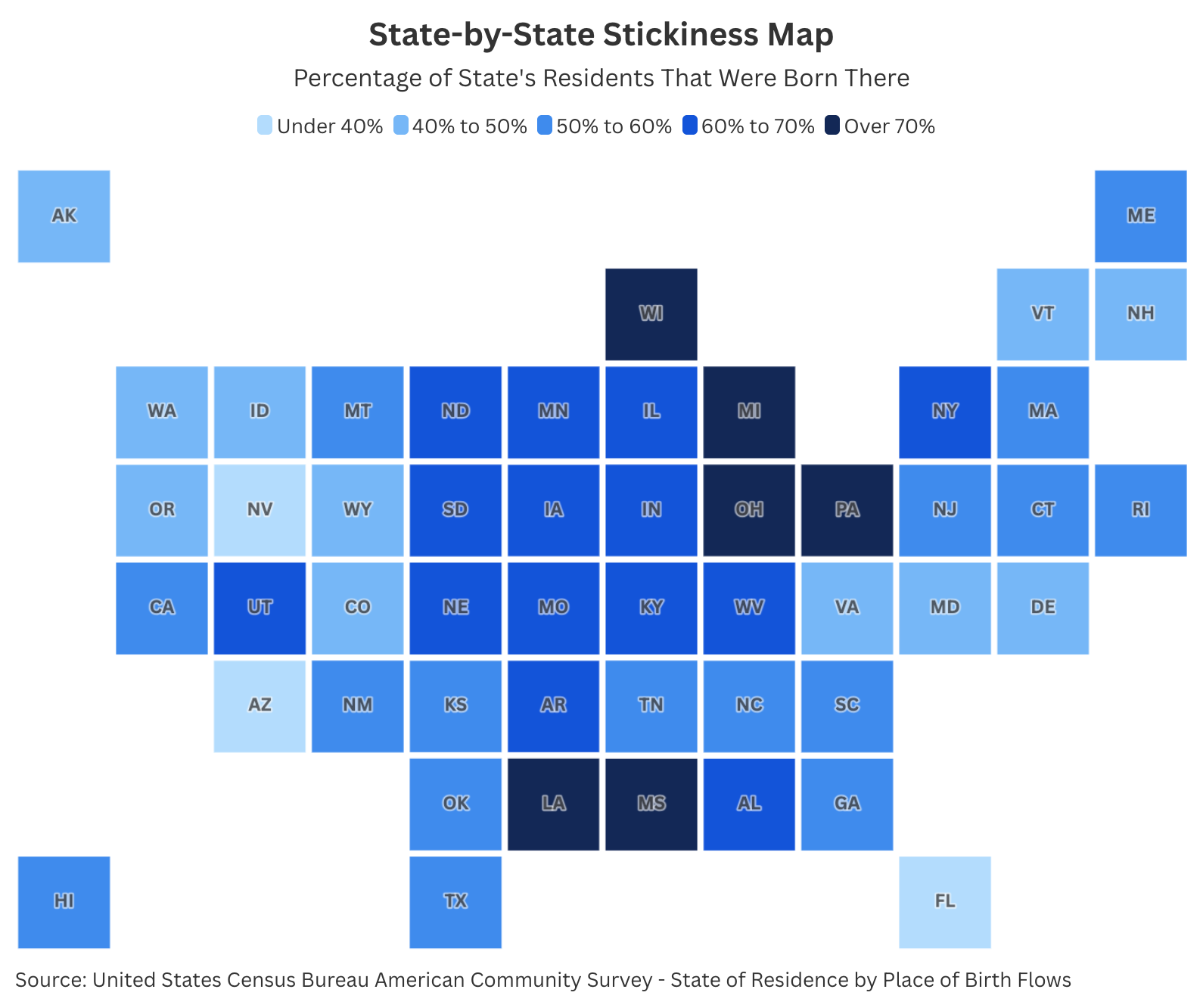
The six states with the highest stickiness are Wisconsin, Michigan, Ohio, Pennsylvania, Louisiana, and Mississippi. The Midwest as a whole boasts an impressive stickiness, with the majority of the states in the region having scores between 60%-70%. The outer fringes of the country feature scores within the 40%-60% range on average.
These results highlight the states where residents have strong local ties to the community. Louisiana, for instance, is deeply rooted in its Creole, Cajun, and French heritage, which historians have connected to lower out-migration compared to other regions.
Additionally, decent housing costs are a strong incentive to remain in the area. Of the six stickiest states across the country, four (Louisiana, Missouri, Michigan, and Ohio) make the list of the 10 cheapest states to buy a home, based on 2025 data from mortgage lender Rocket Mortgage.
When Americans remain close to where they grew up, family is almost always a primary reason. A LendingTree survey of nearly 2,000 American millennials in November 2023 found that 57% lived in their hometowns and an additional 16% lived close by, citing proximity to family as the primary motivator.
With families in the area, deep cultural roots, and job markets that support affordable housing, it's clear to see why many Americans have trouble leaving these states.
The least sticky states: Where people leave
On the other end of the spectrum, high-outflow states often struggle to retain members of their younger generations or locals who have in-demand skills. Based on the latest data from the U.S. Census Bureau American Community Survey, the following three states are seeing the strongest overall outflows:
- Nevada
- Florida
- Arizona
It is worth noting that outflows don't necessarily equate to lost residents. Rather, it could mean these states gain far more newcomers than they keep existing residents. Less than 40% of these states' residents were born there.
Nevada, the lowest state at around 27.2%, is a perfect example. Since at least the early 2010s, people born in Nevada have been a minority in their own state. The Las Vegas Sun first reported this trend in 2011 and noted that tourism growth and migration from California and the Midwest were to blame.
Today, Nevada continues to rely on this in-migration, typically spurred on by taxes, entertainment appeals, or the housing market. Coverage by Nevada Business Magazine makes it clear that business forecasters in 2026 expect that economic diversification and favorable tax structures will keep drawing in new residents, even as homegrown residents remain a minority.
These trends are seen across all five of the aforementioned states.
Why Americans leave: Opportunity, adventure, and fresh starts
Leaving the state where you grew up is typically driven by new opportunity, whether economic or personal. Many movers are young adults who are starting careers in cities, changing lifestyle settings, or just seeking lower living costs.
Data from the LendingTree survey shows that relocators often cite the following five factors as the primary motivators for leaving:
- Better job opportunities
- Higher pay at work
- Access to educational opportunities
- General lifestyle changes
- Climate preferences
Data collected by the U.S. Census Bureau in mid-2022 also shows that domestic migration has increasingly been tied to housing affordability and retirement patterns throughout the early 2020s, showing that there are a slew of reasons for migration patterns in the U.S.
Current migration trends: Where Americans are moving now
One question still remains: Where are Americans moving if not to their hometown? The 2024 Annual National Movers Study, released by major American moving company United Van Lines, tracked inbound and outbound moving percentages to different states across the country and found that the following 10 states, in order, led the charge for inbound states:
- West Virginia
- Delaware
- South Carolina
- District of Columbia
- North Carolina
- Alabama
- Rhode Island
- Oregon
- Arkansas
- Arizona
While reasons for moving vary greatly from state to state and person to person, proximity to family, lifestyle changes, and affordability were among the most commonly cited causes for moves.
What home will mean for the next generation
Mobility in America has never been purely economic or cultural, but rather a blend of identity, family, and opportunity. Steady movement across state lines will most likely continue in the future as economic stratification and remote work continue to force people to redefine the word "home."
Current Midwest and Southern metros experiencing growth will likely continue to experience it, both by natives staying and newcomers arriving. As the next generation of Americans decides whether to stay rooted or seek new frontiers, the forces shaping migration will increasingly reflect a simple truth: Home still matters, but it may not be the place you were born.
This story was produced by ThatsThem and reviewed and distributed by Stacker.